|
|
 |
Graph Gallery

Technical Analysis is today the mainstay of forecasting currency movements, especially for the purposes of speculative trading and hedging for risk management purposes. For most accounts and purposes, we may not be incorrect in saying that Technical Analysis has today gained a vast lead over Fundamental Analysis as the discipline of choice for market forecasting. There are 4 main schools of Technical Analysis, namely:
Classical Charting, which makes use of Trendlines and chart patterns such as Shoulder-Head-Shoulder, Double (or Triple) Bottoms/ Tops, Triangles, Wedges, Flags, Pennants etc. Perhaps the most important component of Classical Charting is the Trendline and the adage "The Trend is your Friend"
Elliot Waves Analysis, which professes that markets move up and down in Supercycles, Cycles, Sub-cycles and Waves in a 5-3 sequence. Elliot Wave practitioners often use Fibonacci retracements and projections in their work, although the use of Fibonacci retracements is not, and should not be, limited to Elliot Wave specialists. Elliot Waves can be powerful tools for forecasting, provided a person happens to start the Wave Count from the correct place. Often, however, there are "alternate Wave Counts" available and as such there is a large degree of subjectivity in Elliot Wave analysis, which can sometimes lead to fatal mistakes.
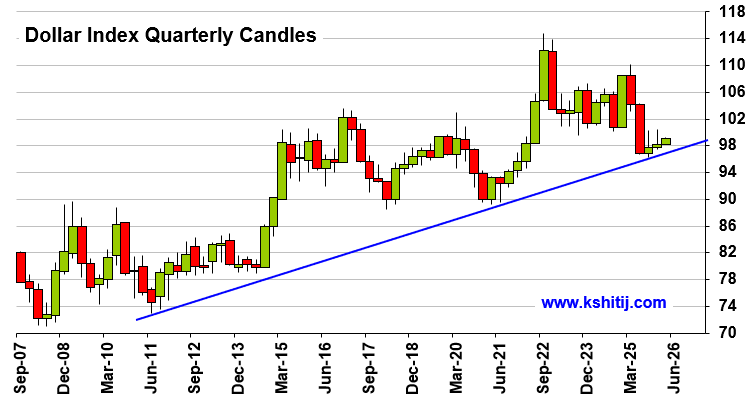
Candlestick Charting is an esoteric art originating from Japan where Rice Traders centuries ago developed this tool for forecasting market movements. Each period's movement is recorded in a Candle (Doji), where a White Candle shows that the Closing price for the period (whether an Hour, Day, 3-days or Week) has been higher than the Opening, while a Black candle shows that the market has fallen to close below the opening in that particular period. In this, Candlestick Charts are visually more informative than the Bar Charts developed by the West. Proper Candlestick Charting involves the recognition of a diverse range of patterns involving clusters of 2-3 candles, with names such a Morning Star, Three Crows, Hammer, Haging Man etc. Trading using Candles requires a lot of patience, but those who have mastered this art swear by its effectiveness and accuracy.
Finally, we have the newest development in the field of Technical Analysis in the form of Moving Averages and Oscillators such as Momentum, RSI, Stochastics and Moving Average Convergence and Divergence (MACD). These are series of data derived through mathematical formulae which work upon the base price data. They are extremely helpful in identifying turnarounds in trends (tops and bottoms) as also in signaling whether a trend, once established, is still in force or not.
We rely on a combination of the above tools and schools of thought - Classical Charting, Fibonacci retracements, Candles (for their visual appeal), Moving Averages and Oscillators to try and make our forecasts and formulate our trades. Many charts that we use are developed inhouse and we present some of them here for your benefit. They are updated once a day right now. Please feel free to use them daily and e-mail us with any comments/ queries/ suggestions that you may have.
Thank You and Happy Charting!
For those who like to follow economic news and data releases, we have some unique Fundamenal Charts. Click here!
|
|
Economic Calendar
|
Disclaimer: These graphs are accurate to the best of our knowledge, but are not guaranteed for accuracy. They are displayed solely for reference purposes, without any liabilities devolving on ourselves.
Indian Rupee against other currencies by Matii Tukiainen
Rates Charts
Disclaimer: These graphs are accurate to the best of our knowledge, but are not guaranteed for accuracy. They are displayed solely for reference purposes, without any liabilities devolving on ourselves.
Indian Rupee Market | FX Thoughts | Economic Calendar | Graphs Gallery | Colour of Money | Money Markets | Research | Risk Management | Government Policies | Utilities & Humour | Free Data | Your Queries | Testimonials | Links | About Us | Site Map

|